Susannah Wright (1697-1784) was an English/American poet, botanist, scholar and civic leader. A renaissance woman, independently wealthy, unmarried, she was known as the “Susquehanna Muse”. Her poetry covered a wide range of topics: death, marriage, time and friends, and it had a strain of mysticism. She focused especially on the plight of women. Though written privately, her verse survives in the posthumous Milcah Martha Moore’s Book. Wright was also a botanist, who was the first to cultivate silkworms in Pennsylvania, helping to establish the silk industry there. (Some of the silk she grew was made into a dress for Queen Charlotte, it is said). A scholar, she spoke several languages and was widely read in science, agriculture and literature. She was also a correspondent to leading intellectuals, such as Benjamin Franklin and James Logan. (A friend noted that she had a “….relish for books, that she could not live without them, that the pleasure of reading was to her a most tremendous blessing”.) As well, she was active in her community as a clerk of the law court, a political adviser to the Pennsylvania government and a benefactor to the sick and poor.
Wright was born into an English Quaker family, emigrating to the American colonies as a young woman. Her father was a Quaker minister and a close associate of William Penn. Because Friends believed in educating both girls and boys, he made sure she received a good education. Her family joined with other Quakers to settle the Conejohela Valley in south central Pennsylvania, then considered the frontier. She was close to several prominent Friends, like Benjamin Rush, Isaac Norris, Robert Proud and Hannah Griffitts. Wright was greatly concerned about women and Native American’s rights. Though a Quaker, she owned slaves and supported war. She never had her portrait painted, something many Friends of the time avoided. A friend, however, described her as “. . . being educated a Quaker (tho her good sense will not suffer her to retain the stiffness and formalities of one) she is remarkably plain in her dress & manner of living”.
Susannah Wright composed verse that reflected her remarkable character: learned, vivacious, outspoken. To a young friend about the oppression of women by men, in her poem “To Eliza Norris – at Fairhill”, she wrote:
He only rules those who of choice obey;/When strip’d of power, & plac’d in equal light,/Angels shall judge who had the better right,/All you can do is but to let him see/That woman still shall sure his equal be,/By your example shake his ancient law,/And shine yourself, the finish’d piece you draw.
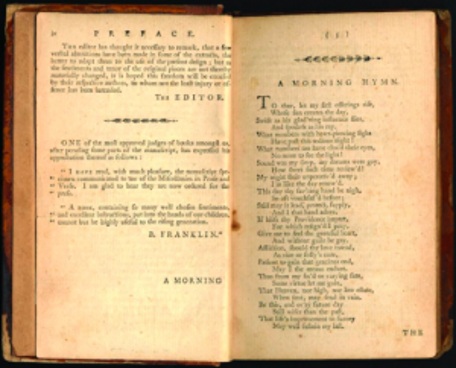
(Above is Wright’s “The Morning Hymn” from Milcah Martha Moore’s Book.
Gary Sandman
September 2026