Francis Hole

Francis Hole told a story once in his Touching the Earth program: a Professor of Soil Science at the University of Wisconsin at Madison, one day he was lying on his stomach on a patch of grass on the campus.  He was examining the ground for worms.  After a time, he glimpsed a pair of feet nearby.  He looked up and saw a teary-eyed coed staring at him.  She murmured, “You poor man!”, scurried over, placed a dollar by him and dashed away.  Smiling, Francis noted, “I guess she thought I was drunk!”

Francis Hole (1913-2002) was a musician, puppeteer, writer and teacher.  He was known for his contribution to recording the soils and their properties in the Wisconsin region.  He was also known for his use of humorous talks and arts to popularize soil science, employing his violin and puppets, especially in the Touching the Earth program.  Another high point of his career was his campaign to get Antigo Silt Loam recognized as the official state soil of Wisconsin.  Francis published over 50 books on technical and pedagogical aspects of soil science.  His work led him to be dubbed the “Ambassador of Soils” and the “Poet Laureate of Soil Science”.  He, on the other hand, always introduced himself as “Francis D. Hole, TNS” (Temporarily Not Soil).

Francis Hole grew up a Quaker in Friends Churches in Richmond, Indiana.  He attended Haverford College and Earlham College, where he first participated in unprogrammed worship.  During World War Two, he was a conscientious objector, serving on a trail-clearing crew in the Great Smoky Mountain National Park and as an assistant in U.S. Department of Agriculture laboratories.  In 1946 Francis became one of the founding members of Madison (NYM) Meeting.  (He stated that he liked Madison Friends very much, not the least because it was marvelous that scholarly people could be silent most of the time).   He wrote for Friends Journal and other Quaker publications, and he co-wrote, with Ellie Shacter, A Little Journal of Devotions Out of Quaker Worship, a collection of spiritual messages. He was also a regular speaker at Friends events.

I saw Francis Hole perform his Touching the Earth program at Friends General Conference Gathering, and I danced when he played his violin for square-dances at Northern Yearly Meeting at Wild Rose.  He struck me as sprightly and wise, one of those wonderful older Friends I met when I first came into Friends Meetings in the early 1970’s.  They were the kind of people I wanted to grow up to be.

Below is a link to an interview with Francis Hole.  There’s not much talk about art but I was touched to see one of those older Friends again.

And a quote:

“Green vegetation and the ground on which we step are bathed in sunlight – but not plant roots, not our own Inner Light. They work in blessed darkness.”

Gary Sandman

February 2020

The Bridgetown Meetinghouse Photograph

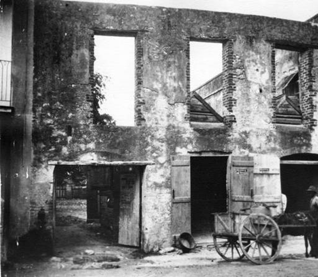
A photograph of the ruins of the Bridgetown Friends Meetinghouse in Barbados was taken in 1906.  The photographer was anonymous, but at one time the photograph was in the possession of Robert Moon.  The photograph rests now in the George Vaux, Jr., papers at the Haverford College Quaker Collection.  The Bridgetown Meetinghouse was built c. 1665.  During the time of persecution, for a period, Governor Atkins closed it and had all the benches removed.  General Meetings of all the island’s Quakers took place there.  A hurricane destroyed it in 1780.  It is gone now, though its site is marked by a plaque.

Barbados was the first outpost of Friends, predating Pennsylvania, and was called the “Nursery of Truth”.  Ann Austin and Mary Fisher, the earliest Quaker missionaries to the Americas, came in 1655 and were followed by many others, including Elizabeth Hooton, William Edmundson and George Fox.  A large contingent of Friends gathered by 1660, arriving as convicts or immigrants.  In turn, they converted many on the island to Quakerism, including several leading families.  By 1700 there were about 1200 Friends with six Meetinghouses and four cemeteries.  Friends were persecuted for many reasons, including their refusal to serve in the militia and their efforts to convert slaves to Quakerism.  (“An Act to Prevent the People Called Quakers from Bringing Negroes into their Meetings” was enacted by the House Assembly of Barbados).  And yet Friends survived, generations of them living and dying there.  The oppression took its toll, however.  Over the years Friends emigrated to Pennsylvania or South Carolina or became Anglicans.  By 1820 there were no Quakers in Barbados.  All the Meetinghouses were torn down, and most of the cemeteries were forgotten or paved over.  Only the Cliff Burial Ground survives, and a Quaker Road lies in the west of the island.

Friends first faced slavery in Barbados.  While there were some slaves in England, there were many of them in Barbados due to the labor needed for the tobacco and sugar industries.  George Fox called for humane conditions and manumission in 1671.  William Edmundson went further, condemning slavery outright in 1675.  Yet most Friends owned slaves.  They tried to find a middle ground: better treatment, education, freedom after a period of years, etc.  In the end, however, that compromise failed, and it was one of the reasons they left Barbados.  But they took with them seeds that would later bloom into abolitionism.

The Bridgetown Friends Meetinghouse photograph is haunting.  The Meetinghouse it depicts was nearly 250 years old by the time of the photograph.  Thousands of Friends had passed through those doors.  It shows a community that vanished.

Gary Sandman

January 2022

Quakers and Dance

Quakers rejected dance for most of their history.

In the Founding Period, from about 1650 to 1700, Friends wrote and witnessed against dance. Emerging from the Puritan movement, Quakers felt that art, including dance, was sinful. Humphrey Smith in “To Musicioners, to the Harpers, the Minstrels, the Singers, the Dancers, the Persecutors: from one who loved Dancing and Musick as his Life” criticized dance based on scripture. In No Cross, No Crown William Penn saw dance as a temptation to immorality. Thomas Ellwood in “All is Vanity” viewed dance as a path to misery. Robert Barclay in An Apology for the True Christian Divinity summarized Friends objections. Penn’s original charter for Philadelphia specified a committee “that all wicked and scandalous living may be prevented”, including dance.

In 1658 Richard Davies, a Welsh Quaker, visited a “merry night”, near Llanfair, at which a dance was to be held. He lectured the crowd, quoting from Job, declaring that they might waste their time in mirth but the grave was waiting for them. Remarkably, the people thanked him and some of them even escorted him back to his home. (Davies did not say if the dancers had been drinking, a possibility given their understanding attitude).

In the Quietist Period, from around 1700 to 1900, Friends continued to write and witness against dance. Thomas Lawson in A Mite to the Treasury stated that dance was a bad influence on children. Christopher Meidel in “Assembled to Dance” denounced dance as a pagan activity. In “An Exhortation in Christian Love”, Abiah Darby called dance vanity. Epistles and Advices from Yearly Meetings also reflected these concerns. Thomas Clarkson in A Portraiture of Quakerism further summarized Friends objections. John Kelsall witnessed against people dancing around a maypole. When he attended a dance, Job Scott experienced anguish.

In 1736 Elizabeth Sullivan, a Pennsylvania woman, converted to Quakerism. Her husband was horrified. He had fallen in love with her because of the way she danced, but now she refused to dance. He forced her to leave Pennsylvania, feeling that Friends had contaminated her. After they stopped at a tavern in Delaware, he told the people there how his wife had become a Quaker, even using “thee” to him. A fiddler present offered to play so they could make her dance. Calling her a “Stiff Quaker”, her husband told her she must dance. Sullivan begged to be excused but, as she began to weep, her husband dragged her out onto the floor. The fiddler, noting her tears, said, “I’ll play no more. Let your wife alone”.

In the Modern Period, from approximately 1900 to the present time, Friends began to write in support of dance and to accept dance. William Charles Braithwaite, a Quaker leader, in a statement from the Manchester Conference boldly supported art as a rich source of the Spirit of God, a turning point that made it possible for Friends to take a new view of dance. In Britain Yearly Meeting’s Faith and Practice Jennifer Fishpool stated that dance allowed her to be centered. In North Pacific Yearly Meeting’s Faith and Practice Jim Pym saw dance as healing. An anonymous Friend in New York Yearly Meeting’s Faith and Practice observed that God shares Truth in dance. Charles Roberts toured as a dancer in vaudeville and nightclubs. June Yungblut danced with the Mettler Studio. The real break-through came in the 1950’s when folk dancing was introduced widely in Friends schools. Nowadays Friends Churches in North America and Africa include dance in their worship services. Pendle Hill and Woodbrooke offer dance workshops while dance parties and dance workshops often take place at Friends General Conference Gatherings. Viewing their dance as ministry, the Friendly FolkDancers tour internationally. The Leaveners, the British Young Friends arts troupe, often include dance in their events. “Friend Speaks My Mind”, a video created by Jon Watts, depicts a Meeting for Worship, which becomes a dance party. One of the premier American dancers and choreographers is Twyla Tharp, an Indiana Friend.

In 1991, during the final Meeting for Worship at Illinois Yearly Meeting, in the old Clear Creek Meetinghouse, a Friend spoke about Roy, a Quaker who had died recently. Roy had spoken in tongues during worship at past Yearly Meetings. The Friend expressed appreciation for his ministry. At the end of her deeply felt message, there was a long pause. Then one by one, in memory of Roy, people began to rise. They joined hands and, for a time, about 150 Quakers danced silently in a circle. I was one of them.

Like David dancing before God, in 2 Samuel, Friends have come to celebrate dance.

Gary Sandman

December 2021

Violet Oakley

I have always loved Violet Oakley’s murals.  They are like jewels on walls.

Violet Oakley (1874-1961) was an American painter, author, teacher and speaker.  Her art blended Pre-Raphaelitism and Art Deco and contained a hint of Impressionism.  Her themes were peace and equality, depicted in historical and literary allegories.  Among her many works were stained glass, book and magazine illustrations, portraits, manuscript illuminations, posters and, especially, murals.  Her murals adorn the Pennsylvania State Capitol, Germantown First Presbyterian Church, the Fleisher Art Memorial, Vassar College and numerous other sites.  Oakley also published Law Triumphant, a portfolio of portraits of League of Nations delegates and other dignitaries.  She was awarded the Gold Medal from the Saint Louis International Exposition, the Gold Medal of Honor from the Pennsylvania Academy of Fine Arts and the Medal of Honor from the Panama–Pacific International Exposition.

Oakley was greatly influenced by Quaker testimonies.  Her interest was inspired by William Penn, whose life she had researched for the Pennsylvania State Capitol murals.  A supporter of the League of Nations and the United Nations, she was also a nuclear disarmament activist.  She was a feminist, too, demanding parity in fees with male painters.  Quaker painter Howard Pyle was her teacher and mentor.  After receiving healing from asthma, she became a Christian Scientist, though she always retained Friendly beliefs.

A quote:

“In time I became so impressed by the belief or testimony of the Quakers against carnal warfare that this idea, the victory of law, or truth over force, became the central idea of my life”.

Below is “Penn’s Vision”, a mural at the Pennsylvania State Capitol in Harrisburg.

Gary Sandman

November 2021

Eric Knight

Eric Knight (1897-1943) was a British/American journalist, novelist, short story writer and screenwriter.  Among his works were Invitation to Life, This Above All and The Flying Yorkshireman.  His most famous book was Lassie Come-Home, the story of a collie who travels a thousand miles back to her young owner.  As well, he co-wrote the “Why We Fight” series, short films explaining American involvement in World War Two.  Knight was a member of the Special Services Division, the United States Army propaganda unit.  He died on a military mission, his plane exploding over Dutch Guiana.  (Captain Otis Bryan, President Roosevelt’s pilot, speculated that a bomb had been planted on Knight’s plane in a botched assassination attempt on the President.  Roosevelt had flown in the same kind of plane and on the same route one day before on his way to the Casablanca Conference).

Knight was from an old Yorkshire Quaker family.  A “Fighting Quaker”, he served in both World Wars.  The first conversation he ever had with Jere Brylawski, his future wife, was about international peace.  Though he believed that peace was desirable, Knight felt that war was inevitable.  He admired conscientious objectors, however.  He was also known to use the plain language with his wife. (In a letter, he wrote her, “It’s me and thee, kid!”)

Knight was a fine writer.  His Lassie Come-Home is a delightful, deceptively simple book.

Gary Sandman

October 2021

Marjory Lester

Marjory Lester (1914-97) was a British painter of watercolors and pastels.  Her subject was the city of Banbury in Oxfordshire, especially the downtown area.  Late in life, after retiring, she began painting.  The paintings were initially for her children and grandchildren.  Memories of Banbury and These Golden Days, her two books of paintings, also included reminiscences of her life in Banbury.  To her surprise, they sold quite well.

Lester was a member of Banbury Quaker Meeting.  She painted two pictures of Banbury Meeting, one depicting Friends entering the Meetinghouse, the other showing Friends sitting in Meeting for Worship.  Both are a mix of Quakers in plain and contemporary clothes, a reflection of the transition of Friends in the early 20th century.  A series of her prints, Quaker and non-Quaker, hang in the Meetinghouse.

Marjory Lester was a charming painter, a sort of Quaker Grandma Moses.  There is an innocence about her pictures.  When I first saw her them, I thought they were a child’s paintings.

Gary Sandman

September 2021

Quaker Artists Book

Dear Friends,

Some Friends have approached me, inquiring about my “Quaker Artists” book. I have been writing a monthly column about Friendly artists since 1983, published the first edition of “Quaker Artists” in 1992 and the second edition of “Quaker Artists” in 2015. Below is some more information. You can also find a large excerpt of the second edition as well as the columns I’ve written since the second edition’s publication at my website at garysandmanartist.com.

DID YOU KNOW ….

*that Judi Dench, James Michener and Annie Oakley were Quakers?

*that Joan Baez, Ben Kingsley and F. Murray Abrahams have attended Friends Meeting?

*that Dave Matthews, Bonnie Raitt and James Dean were raised Quakers?

*that Popeye the Quaker Man, a Quaker Tapestry and Quaker stained glass exists?

*that Bolivian Friends, Rwandan Friends and Chinese Friends art exists?

*that Ben Franklin and Walt Whitman were influenced by Friends?

*that William Penn and Margaret Fell wrote poetry?

The second edition of the book Quaker Artists contains the stories of the above artists and more: 286 reviews in all, a history of Friends, a history of Quaker art, study questions, artist’s queries, 44 reproductions of the artists’ works, 51 illustrations, a bibliography, an alphabetical index and an artist’s index. The period covered is 1659 to 2015. Friends from 18 different countries are included. Poets, painters, dancers, musicians, films and 13 other categories are included. (It is three times the size of the first edition!) Quaker Artists is an entertaining and celebratory read in itself but it has other uses, too: as a resource for study groups, a reference for libraries and a curriculum for First Day Schools.

Gary Sandman, a member of Roanoke Meeting in Roanoke, Virginia, is the author of the second edition of Quaker Artists. To purchase, send check or money order to 214 Summit Way SW, Roanoke VA 24014, garysandman@cox.net. (Please note: I get more of the money from the book when you purchase it directly from me).

To purchase the book online, look at an excerpt or see updates on new QA writings, check his website at garysandmanartist.com.

Paperback, 287 pages: $21. Ebook: $6.

The Conscience Bay Meetinghouse Photographs

In May 1967 unknown persons defaced the Conscience Bay Friends Meetinghouse on the north shore of Long Island. During the night they painted on its walls, “TREASON! TRAITORS! THERE CAN BE NO COMPRIMISE [sic] WITH COMMIES!; $10,000 FOR V.C., A KNIFE IN THE BACK FOR AMERICAN G.I.’S; THE AMERICAN DEAD WILL BE AVENGED!” Several hammer-and-sickle emblems and the words “SAT CONG” also decorated the Meetinghouse. (“SAT CONG” translates as “Kill Communists”). And next to the entrance was scrawled: “THIS IS A GOD-IS-DEAD SO-CALLED ‘CHURCH.’ ” The slogans were in red and brown paint, some of them two feet high.

Conscience Bay Quakers had witnessed for peace during the Vietnam War, writing letters to government officials, giving speeches and joining demonstrations. They had published an American Friends Service Committee statement about the war in local newspapers. As well, they had sent money to Canadian Friends to be forwarded to North Vietnam and to the ship the Phoenix, both contributions to be used for medical supplies for civilians.

Conscience Bay Friends met together, in shock and sadness, after the incident. Considering several options, they decided that they would notify the police, since the vandalism was a felony, but would not prosecute if the vandals were arrested; issue a brief statement to the press; and schedule a time to repaint the Meetinghouse, inviting all who wished to help.

On May 21, about 200 volunteers, including 40 Conscience Bay Quakers, gathered at the Meetinghouse. Included were three Catholic priests, two Unitarian and two Episcopalian ministers, along with members of their congregations, as well as members of the neighboring Presbyterian, Baptist, and Methodist churches, Temple Isaiah and the Ethical Culture Society. Friends from Westbury and Fifteenth Street Meetings and representatives from the American Civil Liberties Union and the Suffolk County Human Relations Commission also came. Some people were not affiliated with any group. Others had called or wrote or sent checks for the paint. A local painter said that he would paint the Meetinghouse for free if “they make a mess of it”. Most of the paint was donated by the Pentagon Chemical and Paint Works in Brooklyn.

People mixed paint, climbed ladders, scraped walls and painted. At one point, so many volunteers had shown up that there was a line waiting to make a symbolic stroke of paint. Children scampered round. Friends served sandwiches and coffee and tried to get everyone to sign the guestbook. By the end of the day, the Meetinghouse had received two coats of paint.

George Nicklin of Westbury and Shelter Island Meetings took two photographs of the work party. One is a close-up; the other is a long shot. Above is the close-up.

In the late 1990’s, I delivered one of my “Quaker Artists” talks to Long Island Quarterly Meeting when it gathered at Conscience Bay Meeting. I was very moved by my visit to the site of this luminous response to hate.

Gary Sandman

August 2021

Hozier

Hozier, full name Andrew Hozier-Byrne, (b. 1990), is an Irish musician. He has been influenced by folk, soul, blues and African music and often focuses on religious and political themes. He is also an admirer of the poet Seamus Heaney. His albums have included Hozier; Wasteland, Baby!; and Nina Cried Power. The singles “Take Me to the Church” and “Nina Cried Power” were international hits. The former is about Russian homophobia; the latter is about the struggle against oppression. Hozier is a member of Home Sweet Home, an organization formed by Irish celebrities, which works on homelessness. As well, he supported the Irish abortion referendum and has donated royalties to the National Association for the Advancement of Colored People and the Black Lives Matter movement. He is an outspoken critic of the Catholic Church in Ireland.


Hozier was raised a Quaker in County Wicklow. Now an agnostic, he retains a great admiration for Friends. He mentions especially the Quaker beliefs of looking for God in each person and the Peace Testimony. He adds that when he was a child, he studied the pattern in the carpet during Meeting for Worship, but as an adult, he thinks he would get more out of the worship.


Hozier is a remarkable artist. His “Nina Cried Power” namechecks many of my heroes: Curtis Mayfield, Patti Smith, John Lennon, Pete Seeger. Like people in the video of the song, it had me weeping.


Here is a link to “Nina Cried Power”: https://www.youtube.com/watch?v=j2YgDua2gpk


Gary Sandman

July 2021

Norman Morrison Poster

Norman Morrison burned himself to death in front of Secretary of Defense McNamara’s windows at the Pentagon on November 2, 1965.  This was in protest of the Vietnam War.  He had been inspired by the Buddhist monks setting themselves on fire in Saigon.  Morrison was a member of Stony Run Meeting in Baltimore, where he was its Executive Secretary.

The Democratic Republic of Vietnam created a poster honoring Morrison in the mid-1960’s.  It depicts him standing in flames.  On his right is part of a banner that says “Stop US Bombing”; on his left are American warplanes.  The caption reads “Certains se sont trouvés culpables” (Some are found guilty).  The artist is anonymous.

The Vietnamese people regard Morrison as a national hero.  They feel he gave his life for their country.  (He is known there as Mo Ri Xon). During the Vietnam War, the Democratic Republic of Vietnam issued a stamp in his honor, and the poet Tố Hữu dedicated the poem “Emily, My Child” to him.  After the war, the cities of Đà Nẵng and Hà Nội named roads for him.  In 2007 the President of the Socialist Republic of Vietnam Nguyễn Minh Triết visited a site near where Morrison died and read Tố Hữu’s poem to commemorate him.

I remain convinced that Norman Morrison’s act was wrong.  But I remain haunted by it.

Gary Sandman

June 2021