Angela Manno (b. 1953) is an American painter, who has based much of her work on the environment. A prolific artist, she has created in many mediums: pastel, oil and encaustic, egg tempera and gold leaf, batik on silk and cotton, mixed media and photography. She is known especially for her icons, including the Sacred Biodiversity Oracle, a 36 card deck depicting threatened species. She has also created numerous landscapes, especially of Colorado and Provence. Manno’s aim is to elevate non-human species to their rightful and equal place in the community of being and to spark passion in people for the living world. Conscious Evolution: The World At One, an exhibition collected by the National Aeronautics and Space Administration, focused on global unity and responsibility. Responding to the Cry of the Earth, an audio-visual program commissioned by the Vatican, featured images of threatened species. Manno is a three-time grant recipient from the Xerox Corporation. Among other places, her works have been exhibited in the Smithsonian Institution’s National Air & Space Museum, the National Museum of Women in the Arts and the American Museum of Natural History and reside in many private collections around the world.
Manno has been active with Friends since attending Friends Academy as a young person, a life-changing experience for her. She has been an attender at Fifteenth Street Meeting in New York City and at Forres Meeting in Scotland. The Sacred Biodiversity Oracle was inspired in part by Friends worship-sharing. Among other Friendly organizations, she has been active with New York Yearly Meeting Friends in Unity with Nature and with the national Quaker Earthcare Witness. For NYYM, she helped create the NYYM Earthcare curriculum, and she developed and presented “Eco-Spirituality & Action”, a course that led to the Peace with Earth Declaration. She is a graduate of the School of the Spirit’s program “Quaker Ministry: On Being a Spiritual Nurturer”.
Angela Manno’s icons are exquisite, a deep and special view of all beings.
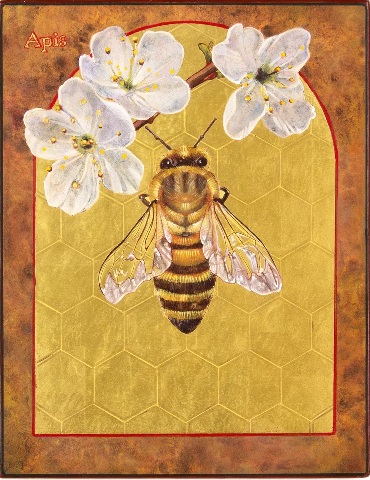
(Above is the icon “Apis, the Honey Bee” from her series Contemporary Icons of Threatened and Endangered Species).
Gary Sandman
February 2026